
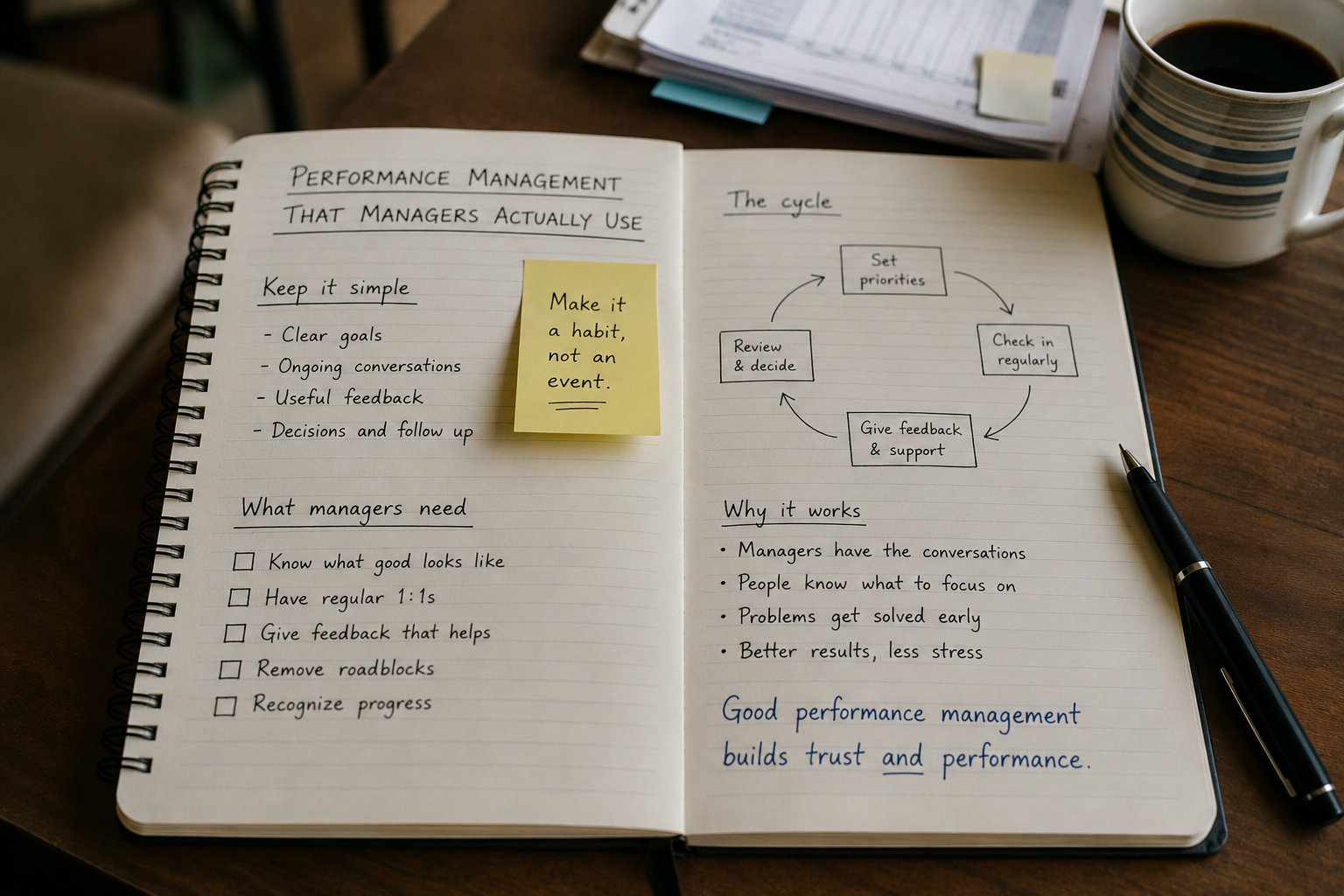
Performance management fails when it is designed as an annual HR event rather than a recurring management practice. A completed form may satisfy the process, but it does not help a manager set priorities, remove obstacles, recognize contribution or respond when performance changes.
A useful system gives managers a small number of clear expectations, timely evidence and a consistent rhythm for conversation. It connects individual work to team outcomes while giving employees enough context to make decisions without waiting for the next appraisal cycle.
Why appraisal systems are often ignored
Many systems ask managers to score too many competencies, interpret vague rating scales and reconstruct a year of performance from recent memory. Goals may be set after work has already begun, while measures depend on data that is not available or trusted.
The result is predictable: reviews become late, ratings cluster in the middle, difficult conversations are deferred and employees see little connection between feedback, development, recognition and opportunity.
The test of performance management is not whether every form is complete. It is whether managers make clearer, fairer and earlier people decisions.
Can each employee explain the few outcomes that matter most?
Can the manager discuss progress using current, trusted information?
Are feedback and support provided before a formal rating?
Does the process lead to a decision, commitment or development step?
Replace the annual event with a management cycle
Formal reviews still have a role, but they should summarize an established cycle rather than introduce unexpected conclusions. A simple rhythm keeps attention on performance without creating continuous paperwork.
Align
Translate priorities into specific outcomes, boundaries and measures.
Check in
Review progress, obstacles, support and changing assumptions.
Coach
Give evidence-based feedback close to the work.
Decide
Recognize, develop, redirect or address underperformance.
The frequency should reflect the work. Monthly conversations may suit operational roles with visible measures; project-based reviews may suit advisory teams; quarterly discussions may suit leadership roles. What matters is that the cycle is known and decisions are documented proportionately.
Design principle
Make the conversation more valuable than the form.
Give managers a short structure for discussing outcomes, evidence, obstacles, behavior and next actions. Record the decisions—not a transcript of the meeting.
Build KPIs managers can manage
A KPI should help someone make a decision. Measures that are outside the employee’s influence, available too late or disconnected from team outcomes create argument rather than accountability.
Outcomes
What result must the role produce—for example collection, delivery, quality, margin, service or capability?
Drivers
Which controllable activities predict the result early enough for the manager and employee to respond?
Guardrails
Which quality, risk, conduct or compliance measures prevent the target from being achieved in the wrong way?
Context
Which assumptions, dependencies and external factors should be considered when interpreting performance?
Most roles need fewer measures than organizations initially propose. A balanced set of three to five outcomes, supported by selected drivers and guardrails, is often more useful than a long scorecard in which priorities compete equally.
Each measure should have:
- A clear definition explaining the calculation, source, frequency and owner.
- A baseline and target that reflect current performance and realistic improvement.
- A line of sight between the person’s decisions and the result.
- A review response describing what the manager should do when performance is outside tolerance.
Use feedback and people data responsibly
Managers need evidence, but people data is rarely complete. Output measures may miss collaboration, learning, complexity or work that prevents future problems. Qualitative judgment remains necessary—and should be made more consistent through examples, calibration and challenge.
Useful data may include delivery, quality, customer feedback, attendance, learning, project contribution, safety, conduct and internal mobility. Access should remain proportionate, confidential information should be protected, and employees should understand how information affects decisions.
What happened, when, and what was the observable effect?
What evidence supports the conclusion, and what context could change it?
What should continue, change or receive additional support?
Who will act, by when, and when will progress be reviewed?
Calibration between managers can reduce inconsistent standards, but it should test evidence rather than negotiate a predetermined rating distribution. The aim is comparable judgment across teams, not forced uniformity.
A focused agenda for the first 90 days
Organizations can improve performance management without replacing every policy or system. Begin with the management behaviors and information that create daily value.
- Simplify role outcomes.Ask each manager to define three to five results that explain what good performance looks like.
- Test the current data.Confirm definitions, sources, timing and ownership; remove measures managers cannot explain or influence.
- Introduce short check-ins.Use a consistent agenda covering progress, obstacles, feedback, support and agreed actions.
- Train through real cases.Help managers practice evidence-based feedback, difficult conversations and fair documentation.
- Calibrate and learn.Review decisions across teams, identify inconsistency and improve guidance before the next cycle.
Performance management becomes useful when it helps managers manage. The organization gains earlier visibility of capability and risk, employees receive clearer expectations, and formal appraisal becomes a fair summary of conversations that have already happened.