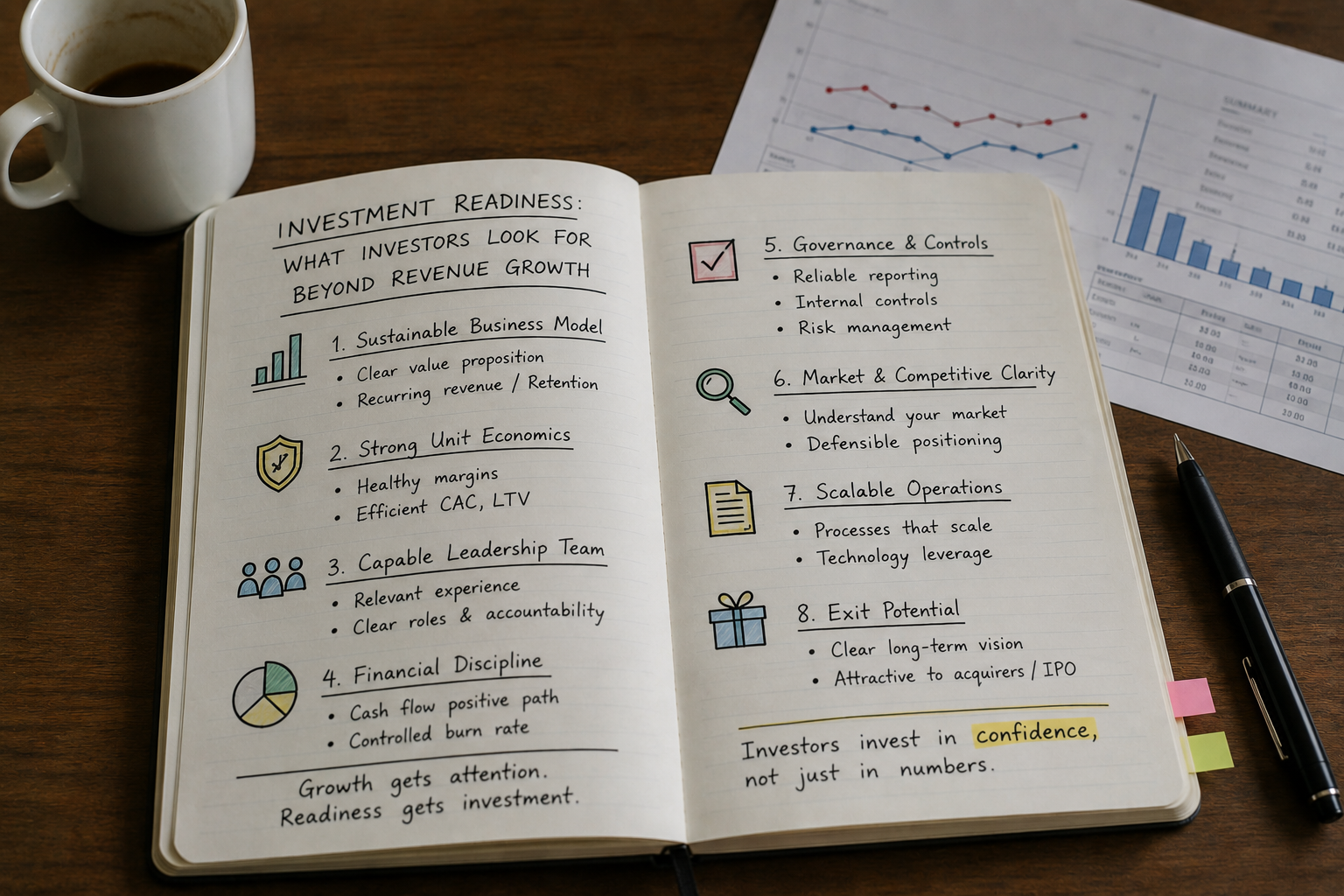
A fast-growing top line can attract attention. It rarely closes a transaction by itself. Investors need to understand whether revenue is repeatable, whether profit converts to cash and whether the management system can support the next stage of growth.
Investors are underwriting the system behind the numbers.
They are looking beyond historical performance to the quality of earnings, working-capital behavior, customer economics, leadership depth and the controls that make reporting dependable. The more capital a business seeks, the more clearly management must connect strategy, operations and finance.
Five files investors try to build.
Every investor has a different mandate, but most diligence processes return to a small set of questions. Preparing the evidence before a process begins gives management more control over timing and narrative.
Quality of revenue
Customer concentration, retention, pricing, contract terms, pipeline conversion and revenue recognition.
Growth depends on a few customers, one-off transactions or aggressive cut-off decisions.
Quality of earnings
Normalized margins, recurring costs, related-party items and a clear bridge from management to statutory results.
Profit relies on adjustments that recur each period or costs that are deferred without a consistent basis.
Cash generation
Working-capital trends, collection behavior, inventory movement, capital expenditure and debt service.
EBITDA grows while operating cash remains structurally weak and overdue receivables accumulate.
Management capability
Leadership depth, decision rights, succession, operating rhythm and the accuracy of management forecasts.
Critical knowledge, customer relationships and approvals depend on one person.
Scalability and control
Systems, compliance, governance, unit economics and a funded plan for deploying new capital.
Growth is increasing manual work, reporting delays, compliance exposure and operational exceptions.
Revenue becomes valuable when its quality is visible.
Two businesses can report the same growth rate and carry very different risk. Investors test how revenue is earned, how long it lasts and what must be spent to retain it.
Show the engine, not only the speed.
A credible commercial picture connects customers, products, price, volume and contribution. It allows an investor to see which parts of growth are repeatable.
- Cohort or customer-level revenue movement
- Retention, churn and repeat-order behavior
- Gross margin by meaningful segment
- Pipeline quality and conversion discipline
Make the revenue bridge reconcilable.
Management reporting, general ledger balances and statutory accounts should tell the same story. Differences need a documented explanation, not a last-minute spreadsheet.
- Consistent recognition policies and contract treatment
- Monthly revenue-to-ledger reconciliation
- Cut-off testing and credit-note analysis
- Clear treatment of discounts, returns and related parties
Profit must travel through the cash cycle.
Cash conversion shows whether the operating model funds itself or consumes capital as it grows. Investors will follow the journey from an accounting sale to available cash.
Recognized
Contract terms and delivery evidence establish when a sale becomes revenue.
01Collected
Credit discipline, disputes and customer behavior determine when revenue becomes cash.
02Converted
Inventory, suppliers, payroll and operating cost determine how much cash growth absorbs.
03Available
Capital expenditure, tax and debt service determine what remains for reinvestment.
04Management capability is part of valuation.
Investors are not only backing a plan. They are assessing whether the organization can deliver it, identify problems early and use capital with discipline.
“A forecast gains credibility when management can explain what changed, why it changed and what action followed.”
Strong teams do not need perfect forecasts. They need a dependable planning rhythm, defined accountabilities and evidence that they learn from variance. That operating discipline reduces execution uncertainty.
Can the business operate beyond the founder?
Show functional ownership, capable second-line leaders and decisions made at the right level.
Does management information change action?
Show concise reporting, recurring performance reviews and documented responses to underperformance.
Is the use of funds specific?
Connect each investment priority to milestones, capacity, cash needs and measurable returns.
Build readiness in three coordinated workstreams.
A data room is useful only when the underlying information is complete, consistent and understood by the people presenting it.
Trust the numbers
- Monthly management accounts and reconciliations
- Historical-to-forecast bridge
- Working-capital and cash analysis
- Tax, debt and contingent-liability schedule
- Quality-of-earnings adjustments
Explain the model
- Customer and product profitability
- Retention and concentration analysis
- Market assumptions and pipeline evidence
- Pricing logic and sales efficiency
- Growth initiatives with accountable owners
Reduce execution risk
- Corporate records and material contracts
- Decision authority and board oversight
- Key policies and compliance status
- Management structure and succession
- Risk register and remediation ownership
Prepare the business before preparing the pitch.
Diagnose the investment story.
Define the capital need, test the equity narrative and identify inconsistencies across financial, commercial and operational information.
Repair the evidence.
Complete priority reconciliations, normalize earnings, analyze cash conversion and resolve the gaps most likely to interrupt diligence.
Rehearse the process.
Build the data room, prepare management responses, pressure-test the forecast and establish a controlled process for investor questions.
Investment readiness is ultimately management readiness.
The strongest process is not the one with the largest data room. It is the one in which reliable evidence, commercial judgment and accountable leadership reinforce the same growth story.