
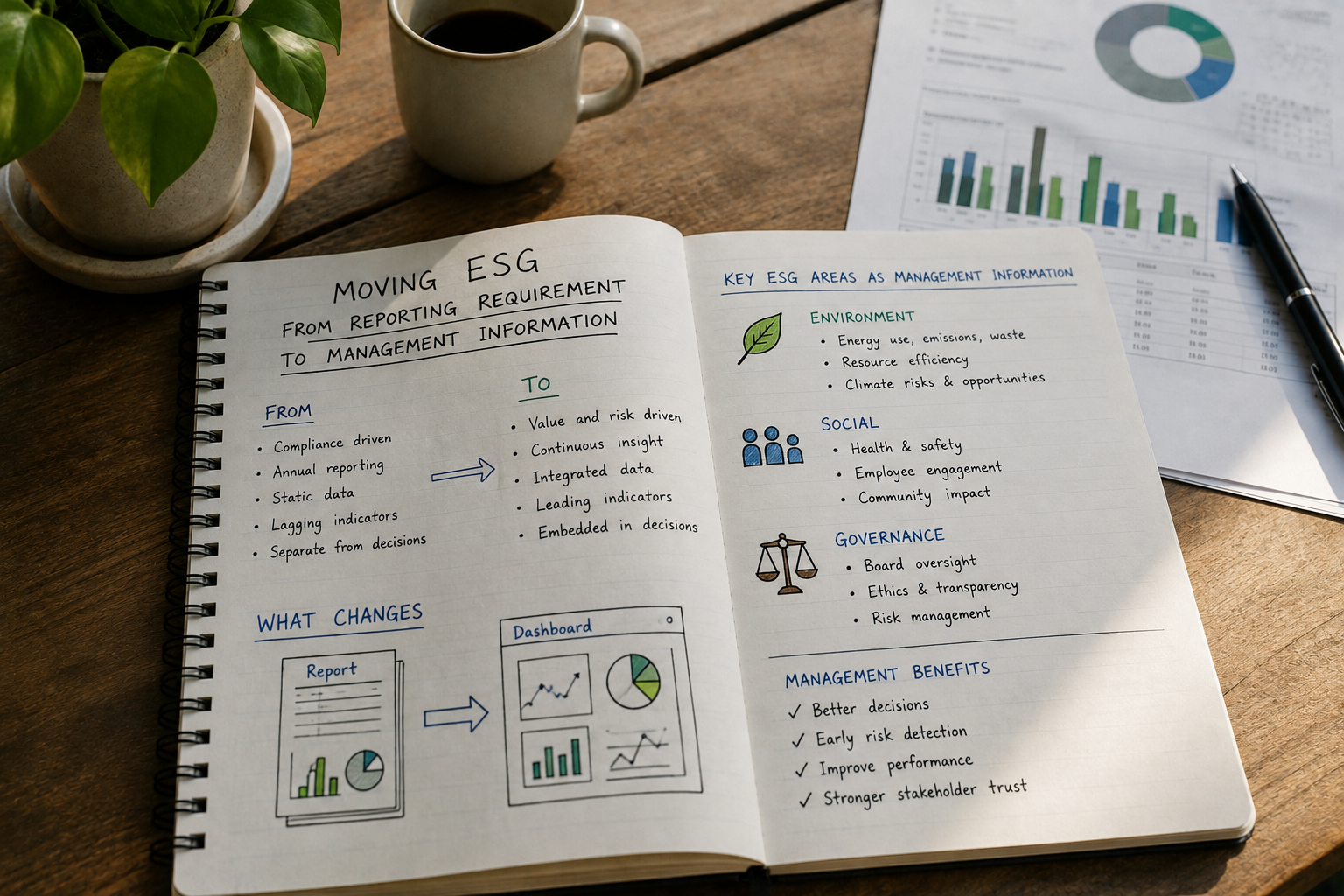
Reporting tells the story.
Management information changes the outcome.
Many organizations now collect environmental, workforce, supplier and governance data. Yet the same information is often absent from operating reviews, investment decisions and performance conversations. The next step is to make ESG information useful before the reporting deadline.
Measure
Collect controlled evidence from the source.
Explain
Interpret movement, exposure and context.
Decide
Choose the response and resolve trade-offs.
Act
Assign an owner, resources and review date.
Move from a disclosure inventory to a decision system.
An accurate metric can still be weak management information. The test is whether it arrives in time, at the right level of detail, with a clear owner and an agreed response.
“What must we disclose?”
The reporting timetable and indicator list determine the work.
- Annual, consolidated measures
- Data owned by the reporting team
- Commentary written after the period
- Success measured by publication
“What must management decide?”
Material choices determine the information, cadence and control.
- Timely, decision-level measures
- Performance owned by operations
- Thresholds linked to a response
- Success measured by action
Five questions turn a sustainability measure into management information.
Use these questions to challenge every material measure before it enters a dashboard or management pack.
What decision will this information support?
A measure without a decision use becomes reporting volume. Define whether it informs operations, investment, sourcing, risk or people decisions.
How quickly can management still influence the result?
The review cadence should match the decision window. Annual information cannot control a weekly or monthly operating exposure.
Where is the performance or exposure located?
Group totals often conceal the site, product, process or supplier that needs attention. Keep enough detail to locate the cause.
Who owns the outcome?
The person submitting data may not control performance. Accountability belongs with a leader who has authority and resources to respond.
What happens when the measure moves outside tolerance?
A target needs a response rule: investigate, correct, escalate, fund, redesign or accept the exposure explicitly.
Connect data, interpretation and action.
A credible ESG information system needs more than a dashboard. It needs controlled evidence, management context and a repeatable decision rhythm.
Controlled data
Create confidence in where the number came from and what it represents.
- Defined boundary and calculation
- Named data source and custodian
- Evidence, review and sign-off
- Known limitations recorded
Decision context
Make movement meaningful to the people expected to respond.
- Baseline, target and tolerance
- Trend and leading indicators
- Operational and financial context
- Clear variance explanation
Action discipline
Turn attention into a decision that can be followed through.
- Responsible executive owner
- Agreed action and resources
- Escalation path
- Completion and impact review
Keep the dashboard short. Make the response visible.
A management pack should show movement, ownership and action at a glance. Supporting evidence can sit beneath it; the first page should direct attention.
What good commentary answers
What changed? Why did it change? Is the evidence reliable? What could the impact be? What action is proposed? When will management know whether the response worked?
One controlled information chain should support both management action and external reporting.
Energy intensity by production line
Owner: COOOn planHigh-risk supplier actions overdue
Owner: ProcurementAttentionLost-time safety incident trend
Owner: Site leadsEscalateWater-stress exposure at key sites
Owner: OperationsMonitorPlace ESG inside normal management governance.
Sustainability becomes operational when it enters the forums where strategy, risk, investment and performance are already managed.
Board
Set direction and challenge material exposure, strategy and risk appetite.
Executive team
Resolve trade-offs, allocate resources and hold leaders accountable.
Operations
Own performance, investigate variance and deliver corrective action.
Finance & control
Strengthen definitions, evidence, consolidation and review.
Sustainability
Coordinate the framework, support capability and provide challenge.
Each material target should sit with a leader who has the authority, resources and management forum needed to change the outcome—not only with the team that compiles the report.
Prove the discipline in 90 days.
Do not wait for a complete reporting transformation. Pilot the management approach around a small number of material decisions and learn from actual use.
Focus
Choose where better sustainability information could change a real business decision.
- Select three to five material decisions
- Name executive and operational owners
- Map existing measures and sources
Design
Create the minimum controlled information and response model managers need.
- Agree definitions and evidence
- Set targets, tolerances and cadence
- Define action and escalation rules
Use
Run the management brief in a real forum and judge it by the decisions it changes.
- Review variance and assign actions
- Track completion and outcomes
- Simplify the pack using feedback
The destination is not a larger ESG report. It is a better-managed organization.
When sustainability information is timely, controlled and connected to choices, external reporting becomes an output of stronger governance rather than a separate annual exercise.