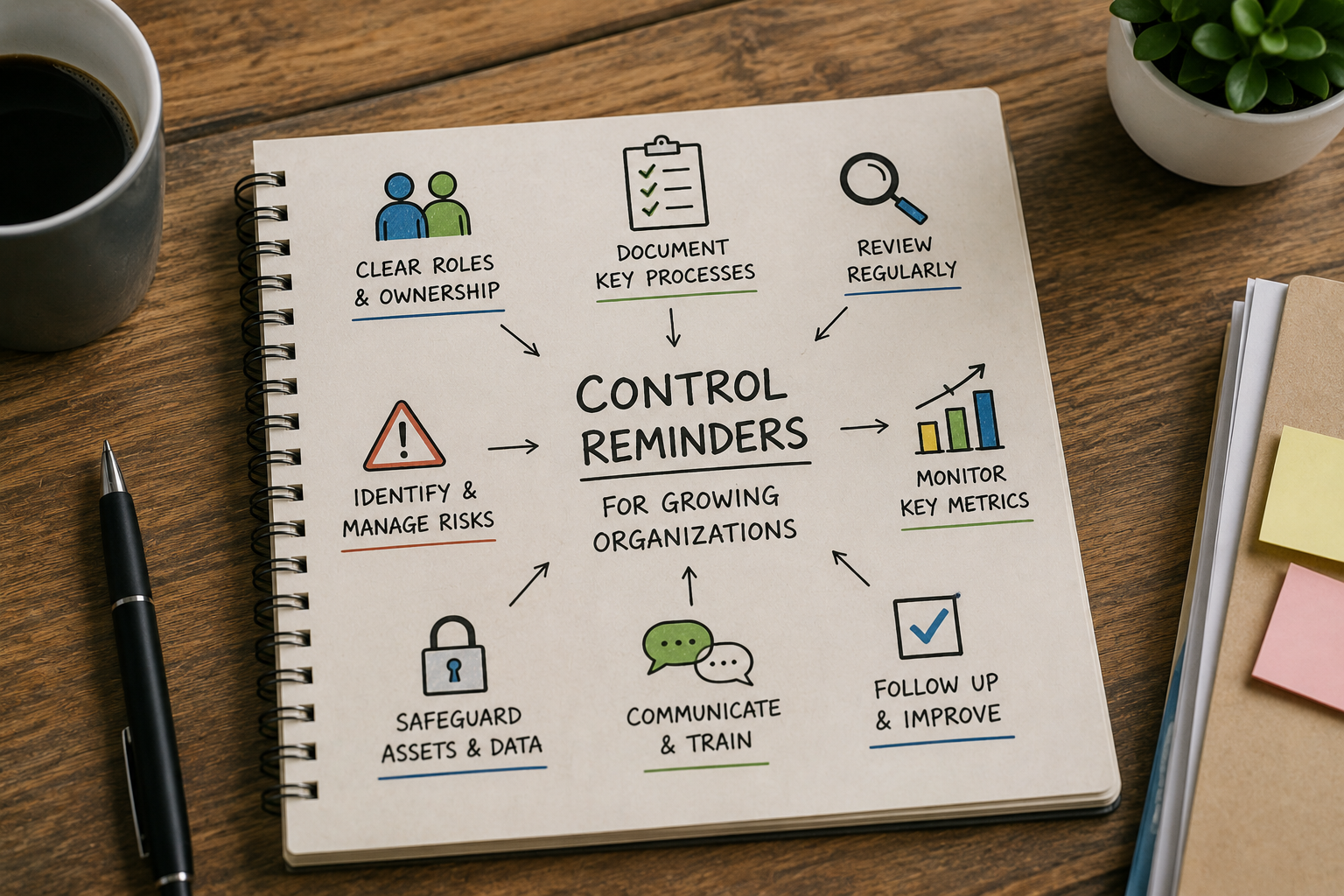
Growth changes the conditions under which controls operate. More transactions, more people, new locations and faster decisions can turn an informal process that once worked into a source of error, delay or hidden exposure.
The answer is not to add approval at every step. Management needs a small number of well-placed controls that protect important decisions, expose exceptions early and preserve enough evidence for someone else to understand what happened.
Controls must keep pace with the operating model
A control designed for a founder-led business may depend on one person seeing every payment, contract or hire. That approach becomes unreliable as responsibility is delegated and transaction volumes increase. Bottlenecks appear, staff find workarounds and nominal approvals become less meaningful.
Each significant change—a new system, branch, product, team or reporting requirement—should trigger a short control review. The objective is to confirm that authority, information, review and escalation still operate at the right points in the process.
Good controls allow responsible delegation. They make the boundaries clear and ensure exceptions reach someone with the authority to act.
Six control reminders for management
Clarify decision rights
Define who can initiate, approve, amend and record material transactions. Align authority limits with current roles, values and risk.
Protect master data
Restrict and review changes to suppliers, customers, bank details, prices, payroll records and other data that drives transactions.
Separate incompatible duties
Where full separation is impractical, introduce an independent review of high-risk combinations such as setup, approval and payment.
Reconcile to independent evidence
Use bank, inventory, payroll, tax and subledger reconciliations to identify differences. Track exceptions through documented closure.
Control system access
Review access after role changes and departures. Monitor privileged users, shared credentials and manual overrides.
Make exceptions visible
Define thresholds, owners and escalation times. A control is incomplete if it detects a problem but does not drive a response.
Design principle
Put the control close to the decision.
A late review may document a failure without preventing it. Place preventive checks before irreversible actions and detective checks early enough for correction to matter.
Warning signs that controls have not scaled
Weaknesses often become visible through recurring operating symptoms before they become major losses or reporting failures.
Routine decisions wait for senior leaders while genuinely unusual items receive no more attention than standard transactions.
Critical reports rely on files with unclear ownership, uncontrolled formulas, copied data or no independent review.
Reconciling items are repeatedly carried forward, reclassified or explained as timing without a verified resolution date.
Employees retain permissions from previous roles or can both create and approve sensitive transactions.
Approvals and documents are assembled only when finance, audit or regulators request them.
Emergency processes become routine, but the reason, approver and downstream review are not consistently recorded.
What management should see
Management information should show whether key controls operate, not simply whether a policy exists. A compact monthly view can focus attention on a few leading indicators.
The measures should prompt decisions. An exception report without action ownership creates observation, not control. Every material issue needs a response, a due date and evidence of closure.
Five actions for the next 30 days
- Select three material processes.Prioritize areas with high value, rapid growth, manual intervention or recurring exceptions.
- Trace one transaction end to end.Follow initiation, authorization, processing, recording, reconciliation and reporting to see where reality departs from policy.
- Review authority and access.Compare current roles with approval limits and system permissions, including recent joiners, movers and leavers.
- Clear or escalate old exceptions.Challenge items repeatedly carried forward and assign the decision needed for final resolution.
- Create a control dashboard.Start with completion, exceptions, overrides and access conflicts; report trends and decisions rather than raw activity.
Growing organizations need controls that are clear enough to follow and proportionate enough to sustain. The most effective systems protect important decisions without obscuring accountability under layers of procedure.
A regular control review helps management preserve that balance. It identifies where growth has changed the risk, removes controls that no longer add value and strengthens the checks that support confident delegation.