
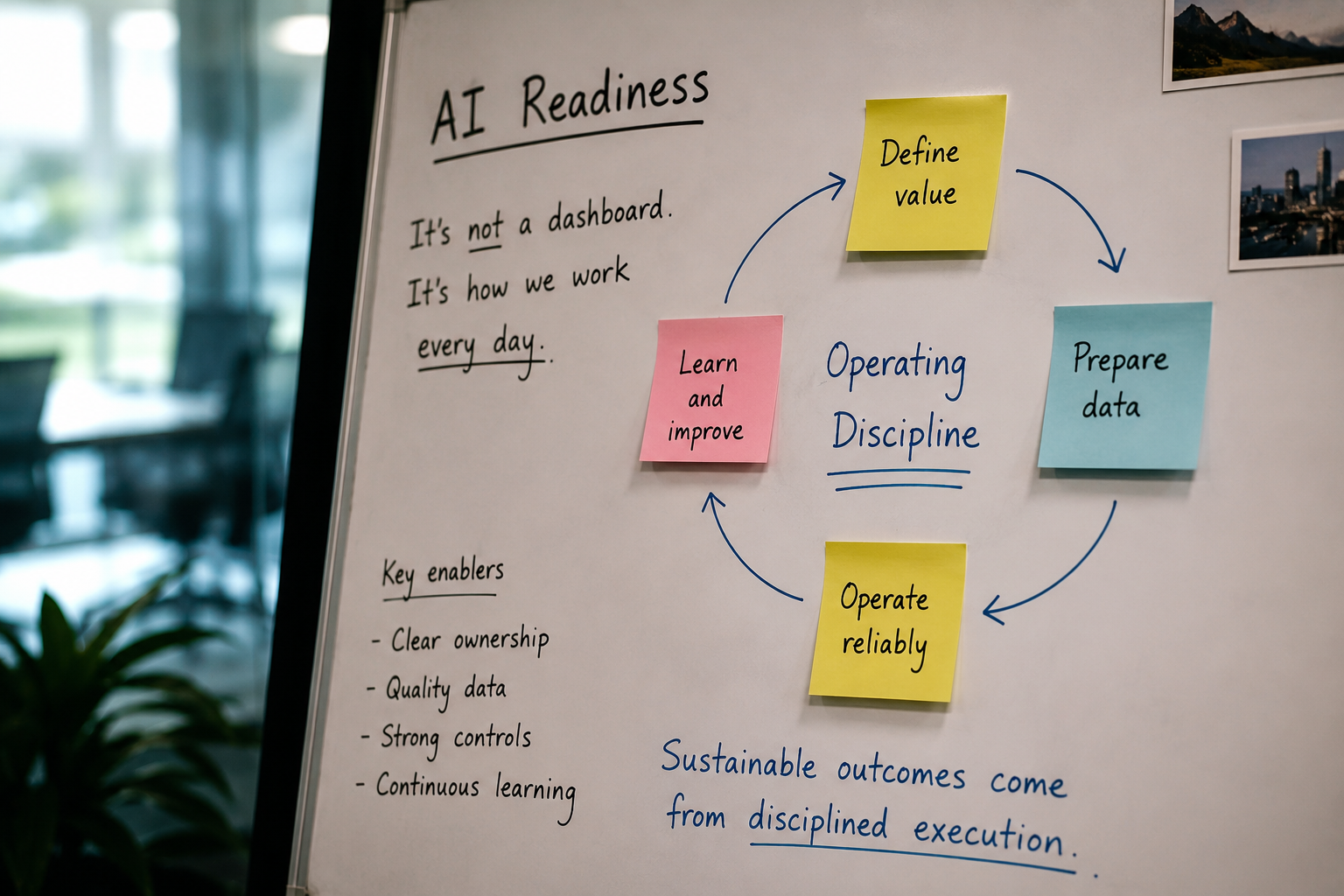
AI readiness is sometimes reduced to a score, a technology purchase or a dashboard of pilot activity. None of these proves that an organization can use AI reliably. Readiness is visible in the way people define problems, manage data, redesign work, review outputs and remain accountable for decisions.
The organizations most likely to generate value are not necessarily those with the largest technology budgets. They are those that can connect a well-defined business need to trusted information, a responsible owner and a process capable of absorbing change.
The dashboard trap
A readiness dashboard can help leadership see activity, but it can also create false confidence. Counting tools, training sessions and experiments says little about whether an AI-enabled process is accurate, adopted, controlled or economically useful.
Readiness must be tested at workflow level. Can the organization explain which data an AI system uses? Can staff challenge an output? Is there a fallback when the system is unavailable? Does someone own the quality of the final decision? If these questions are unanswered, the dashboard is reporting ambition rather than capability.
AI readiness is not a technology state. It is the organization’s ability to change work responsibly and repeatedly.
Five foundations of practical AI readiness
Strong readiness connects strategy and operations. Each foundation must be sufficient for the specific use case; an organization does not need to perfect everything before it begins.
Purpose
A defined business problem, target user, expected outcome and clear reason why AI is appropriate.
Data
Accessible, lawful and sufficiently reliable information with known ownership, limitations and retention rules.
Process
A documented workflow showing where AI assists, where people decide, and how exceptions are handled.
People
Process owners and users who understand the task, can interpret outputs and know when to escalate.
Governance
Proportionate review covering access, security, privacy, accuracy, bias, third parties and accountability.
Weakness in one foundation can undermine the rest. Clean data cannot compensate for an undefined problem, and a promising model cannot create value if the workflow and incentives remain unchanged.
Choose useful use cases, not impressive demos
Early use cases should matter enough to demonstrate value but remain bounded enough to control. Repetitive, document-heavy work with a clear reviewer is often a better starting point than an autonomous, high-consequence decision.
The problem occurs frequently and consumes measurable time or creates recurring delay.
Inputs and desired outputs can be described clearly by the people who perform the work.
A knowledgeable reviewer can verify the output before it affects a customer or decision.
Required data can be accessed responsibly without exposing confidential information unnecessarily.
Success can be measured through quality, time, cost, risk or service—not adoption alone.
The organization can stop, correct or revert the process if performance falls below tolerance.
A portfolio approach helps. Begin with a small number of use cases across productivity, insight and control. Compare expected benefits with implementation effort and potential harm, then scale only after evidence supports the decision.
Selection principle
Start where verification is possible.
The first AI use cases should make human review easier, not hide how an answer was produced or move accountability away from the process owner.
Put governance inside the workflow
AI governance should not operate as a distant approval committee. The essential controls belong inside design, testing, deployment and everyday use. Responsibility must remain with the business owner, supported by technology, risk, legal, compliance and assurance specialists where needed.
- Classify the use case: assess its data sensitivity, decision consequence, external impact and dependence on third parties.
- Define permitted use: tell users what the tool can do, what information it may receive and which decisions require human approval.
- Test real scenarios: include typical work, difficult exceptions, incomplete inputs and deliberately misleading instructions.
- Monitor outcomes: track accuracy, overrides, complaints, failure patterns and whether expected benefits are actually realized.
- Preserve accountability: name the owner who can pause use, address an incident and approve material changes.
Documentation should be concise enough to use. A clear record of purpose, data, testing, limitations, approvals and monitoring is more valuable than a long policy disconnected from operations.
A focused agenda for the first 90 days
A practical readiness programme can establish discipline while still allowing teams to learn quickly.
- Create an AI use-case register.Record current experiments, business owners, tools, data used, users, expected value and risk level.
- Select two bounded workflows.Choose problems with measurable effort, available evidence and a capable human reviewer.
- Map data and decision rights.Identify sources, access, quality gaps, approvals, exceptions and final accountability.
- Run controlled tests.Compare outputs with an agreed baseline and document accuracy, time saved, failure modes and user feedback.
- Decide with evidence.Scale, redesign or stop each pilot based on measured value and acceptable risk—not enthusiasm alone.
The objective is not to declare the organization AI-ready. It is to build the capability to select, govern and improve AI-enabled work one process at a time.
When this discipline becomes routine, AI moves beyond isolated experiments. It becomes part of a controlled operating model in which technology strengthens human judgment, management information and service delivery.