
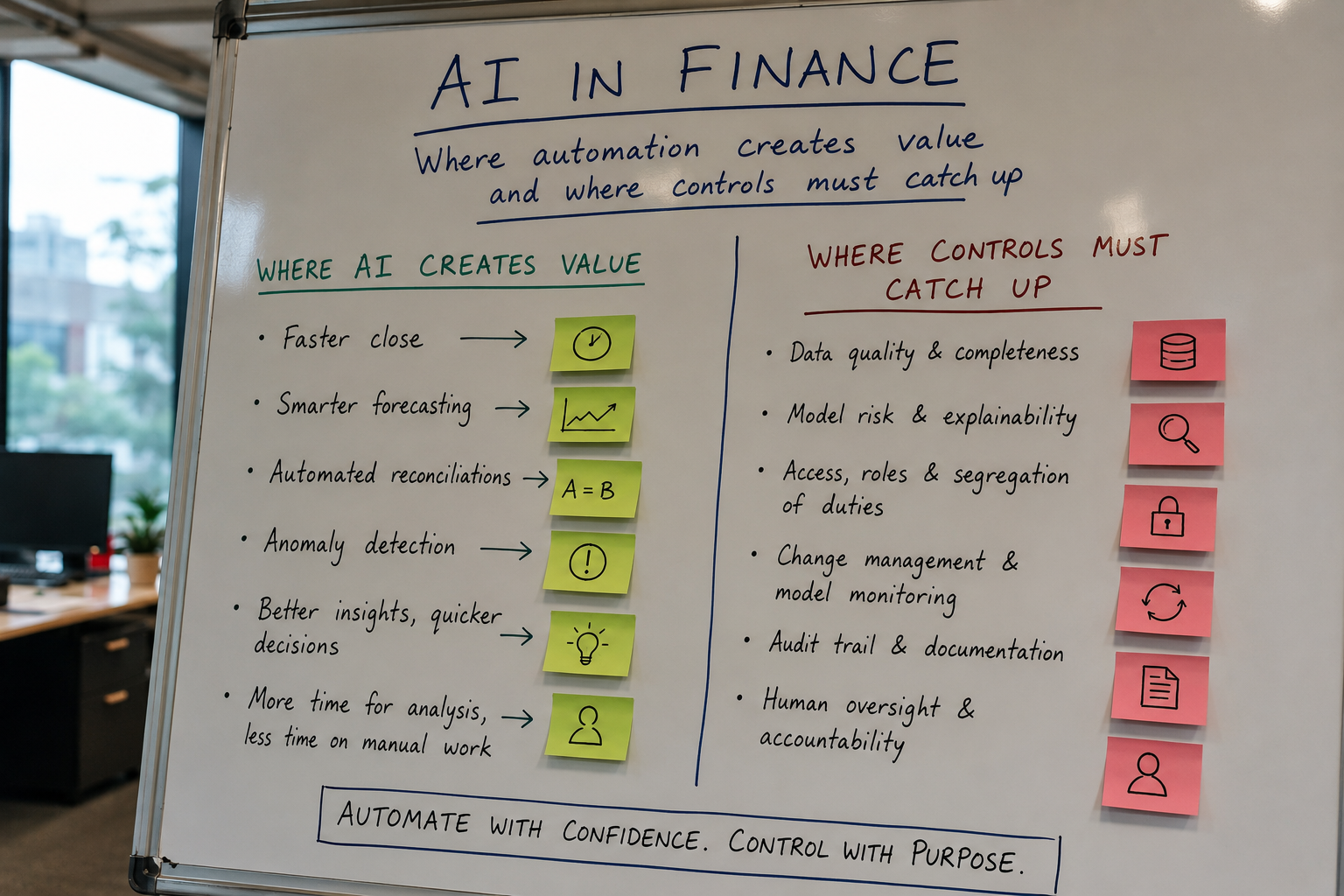
Finance teams are being offered AI for almost every activity: invoice processing, reconciliations, forecasting, narrative reporting, anomaly detection and decision support. The opportunity is real, but value does not come from adding intelligence to a weak process. It comes from redesigning the work and its controls together.
Automation value
Remove repetitive handling, accelerate review and focus people on judgment and exceptions.
Information value
Find patterns across transactions and present relevant evidence closer to the decision.
Control value
Monitor larger populations and direct assurance toward unusual behavior and changing risk.
Where value appears
Four finance zones are moving at different speeds.
The strongest near-term opportunities combine high transaction volume, repeatable patterns and a reviewer who can verify the result. More judgment-heavy work can also benefit, but it requires clearer limits and stronger evidence.
Process and classify
Capture information, suggest coding, match records and prepare routine entries.
- Invoice extraction and validation
- Transaction matching
- Close-task assistance
Explain and assemble
Prepare first drafts, compare results and organize evidence for management review.
- Variance commentary
- Disclosure support
- Management packs
Model and challenge
Analyze drivers, build scenarios and expose assumptions that need management judgment.
- Cash forecasting
- Scenario analysis
- Working-capital signals
Detect and prioritize
Screen populations, identify unusual relationships and target human investigation.
- Anomaly detection
- Control monitoring
- Journal-risk screening
The best finance use case does not simply produce an answer faster. It improves the quality, timing or cost of a defined decision.Value test
Match controls to use
The control response should rise with consequence.
An internal draft and an external filing do not require the same governance. Neither do a suggested transaction code and an autonomous payment decision. Control design should reflect how the output will be used, who could be affected and how easily an error can be reversed.
Assist
Search, summarize, draft and organize information for a knowledgeable user.
Approved tools, data restrictions, user review and clear permitted-use guidance.
Recommend
Suggest coding, forecasts, risk scores or actions that influence a decision.
Testing, thresholds, explanation, documented approval and outcome monitoring.
Execute
Post an entry, release a workflow, communicate externally or change a record.
Restricted authority, preventive rules, logging, exception handling and reliable fallback.
Human review is meaningful only when the reviewer has enough time, information and competence to challenge the output. A click labelled “approve” does not create control if people routinely accept recommendations without examination.
Redesign the workflow
AI should enter a controlled finance process, not sit beside it.
Pilots often fail to scale because the model is tested separately from the real work. A production workflow must connect data access, output review, system action and monitoring.
Define
State the task, user, decision and expected value.
Prepare
Control data, access, instructions and versions.
Review
Set evidence, thresholds and human challenge.
Act
Limit authority and preserve transaction records.
Monitor
Track failures, overrides, value and drift.
Watch the interface
Many failures occur where AI output moves into an ERP, spreadsheet, email or approval workflow. Validate the transfer, preserve traceability and prevent unauthorized action.
Watch the exception
Design for incomplete data, unusual transactions, unavailable systems and low-confidence outputs. The fallback process is part of the control—not an afterthought.
Control priorities
Six questions finance leaders should answer.
Purpose
Define the operational or financial outcome before selecting the tool.
Baseline time, quality, cost, risk and expected improvement.
Data
Identify sources, sensitivity, ownership, quality and permitted use.
Data map, access record, validation results and retention rule.
Output
Separate drafts, recommendations and actions with external consequence.
Review criteria, confidence threshold, approval and audit trail.
Failure
Consider inaccuracy, bias, leakage, manipulation, drift and dependency.
Test cases, incident route, fallback process and stop authority.
A staged roadmap
Move from bounded assistance to governed scale.
Finance teams can learn quickly without creating unmanaged exposure. Each phase should end with a clear decision based on evidence.
- Inventory and select.
Record current AI use, identify sensitive data, and choose one or two bounded workflows with measurable effort and a capable reviewer.
- Test value and control.
Compare outputs with a baseline, document failure modes, train users and verify that review and fallback operate in practice.
- Integrate and monitor.
Connect approved tools to controlled workflows, assign ownership, track value and risk, and reassess after material change.
The objective is not the widest use of AI. It is a finance function that can adopt valuable automation without weakening the integrity of reporting, transactions or decisions.
Organizations that develop these disciplines early will be better positioned to move beyond isolated productivity gains. They can build a controlled system in which AI expands capacity, improves information and supports professional judgment.